Dental chair maintenance works best when the clinic separates routine staff checks from model-specific technical service. A useful schedule should show what to inspect, who is responsible, what evidence to record and when to stop using the equipment and call a qualified technician.
This checklist is general operational guidance for clinic owners, distributors and service coordinators. It does not replace the manual for a specific chair, the instructions for cleaning products or waterline treatment, or local infection-control and electrical requirements. Confirm every interval, lubricant, replacement part and test method for the exact model in service.

Build the maintenance file before setting intervals
Start with the chair model, serial number, installed options and commissioning date. Keep the current operator manual, cleaning instructions, utility diagram, approved parts list and service contacts together. If the delivery unit, operating light, suction system or accessories came from different suppliers, identify the correct document for each component.
Do not copy intervals from another chair simply because the equipment looks similar. Hydraulic and electromechanical designs have different inspection points, and filters, valves, upholstery coverings and water systems may require different products. The hydraulic-system service access checklist explains why maintenance access should also be reviewed before installation.
Daily opening and closing checks
Clinic staff can usually perform visual and operational checks that do not require opening covers or adjusting internal components. Use the model manual and the clinic’s approved procedures to define the exact sequence.
- Before the first patient: inspect visible cables, hoses, controls, delivery arms and the area around the chair base. Confirm that nothing obstructs chair movement.
- Run an operational check: move the chair through the positions needed that day and observe unexpected noise, vibration, hesitation or control faults.
- Check for leakage: look for water, oil or moisture around connections and beneath the unit. Do not assume the source without inspection.
- Clean patient-contact surfaces: follow the chair supplier’s material-compatibility instructions and the clinic’s infection-control procedure. Avoid substituting a product solely because it has a similar label.
- At close-down: complete the approved suction, water and waste-system routine, record any fault and leave the equipment in the shutdown condition specified by the manufacturer.
For upholstery and surface decisions, use the dental chair materials specification checklist to compare the supplied covering with the clinic’s cleaning products.
Weekly inspection and record review
A weekly review should look for patterns that a single daily check may miss. Compare the fault log, inspect accessible filters and traps only as instructed, and verify that warning labels and identification plates remain legible. Check exposed tubing and connectors for abrasion, kinks, discoloration or looseness without dismantling assemblies.
Review stored presets and movement controls for consistent operation. If the unit has accessories on articulated arms, inspect their movement and cable routing. Confirm that removable parts are reinstalled correctly after cleaning. Repeated resets, intermittent controls, pressure changes or recurring leakage should be escalated rather than normalized as “usual behavior.”
Monthly or scheduled service coordination
There is no universal monthly task that applies to every dental chair. Use the manufacturer’s schedule to decide whether a qualified person should inspect fasteners, filters, seals, fluid level, drive components, safety functions or utility connections. Only use the specified lubricant, fluid and replacement part; a visually similar product may be chemically or mechanically incompatible.
Coordinate the chair with the systems that support it. Compressor condition, air quality, suction performance, water treatment and electrical supply can all affect chair operation. The dental air compressor sizing guide and the dental chair installation requirements guide provide related planning checks.
Maintenance responsibility matrix
| Task | Typical owner | Evidence to retain | Escalation trigger |
|---|---|---|---|
| Visual and movement check | Trained clinic staff | Dated checklist or exception log | Unexpected movement, noise, heat or error |
| Approved surface cleaning | Clinic staff | Procedure and product reference | Cracking, tackiness, discoloration or damage |
| Accessible trap or filter care | Person named in the manual | Task date and replacement identifier | Reduced performance or repeated blockage |
| Internal electrical or mechanical work | Qualified service technician | Service report and parts used | Any fault requiring covers to be opened |
| Post-service acceptance | Clinic representative and technician | Functional test and handover record | Unresolved fault or incomplete documentation |
When to stop using the chair
Remove the equipment from service and follow the clinic’s escalation procedure if staff observe exposed or damaged wiring, burning odor, uncontrolled movement, loss of stability, fluid leakage near electrical components, a failed safety function or a fault that recurs after a reset. Isolate utilities only if the person is trained and the model instructions permit it. Do not ask clinical staff to diagnose internal electrical, hydraulic or structural faults.
Photograph the condition where appropriate, record the error message and describe what happened immediately before the fault. Provide the model, serial number, configuration and recent service history to the technician. This is more useful than replacing parts by trial and error.
Procurement checks that reduce future maintenance risk
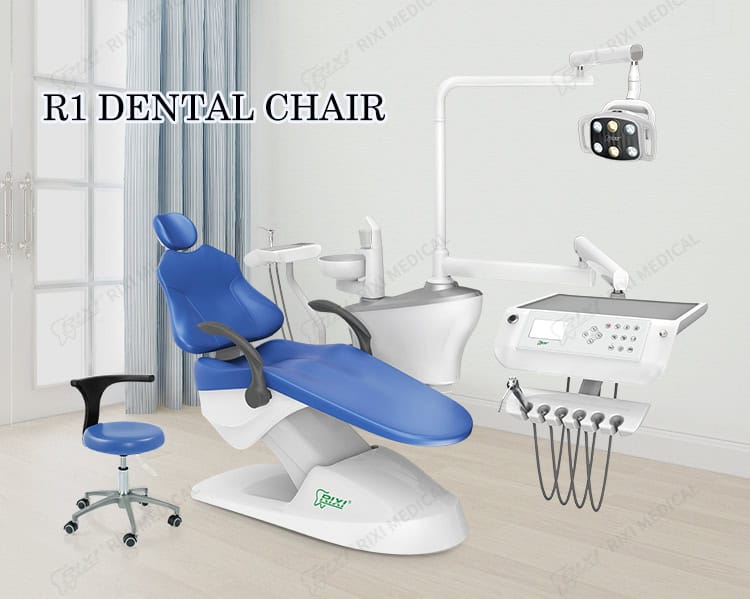
Before ordering, request a current maintenance schedule, exploded parts information where available, service-access guidance, recommended spares and the process for technical escalation. Ask which tasks clinic staff may perform and which require an authorized or qualified technician. Confirm how the supplier identifies compatible parts when the product revision changes.
Compare available dental chair configurations by access, documentation and replacement support as well as visible features. Keep model-specific claims in the supplier’s current quotation and technical documents; this page does not assign a service interval or warranty condition to any pictured model.
Frequently asked questions
How often should a dental chair receive professional service?
Follow the interval stated for the exact model and consider usage, environment and fault history. A generic annual recommendation should not override the manufacturer’s current instructions or local requirements.
Can clinic staff lubricate moving parts?
Only when the model instructions assign that task to the operator and specify the product and method. Internal drive, hydraulic and electrical work should be handled by appropriately qualified service personnel.
What should be recorded after maintenance?
Record the date, equipment identifier, observed condition, work completed, parts and materials used, test results, person responsible and any follow-up action.
Can a replacement part be selected by appearance?
No. Confirm the part number, chair model and applicable revision. Similar-looking seals, tubing, valves or electronic parts may not be compatible.
What should a distributor provide at handover?
Provide the configuration list, manuals, cleaning guidance, maintenance schedule, service contacts and a clear route for parts identification and fault escalation.
Scope note: This article provides procurement and maintenance-planning guidance. It is not a clinical, regulatory or repair procedure.
For model-specific documents or parts identification, use RIXI technical support or contact RIXI Medical with the chair model, serial number and a description of the issue.
Need Dental Equipment Pricing or Configuration Details?
Contact RIXI Medical for model comparison, distributor pricing, packaging information, OEM/ODM requirements and after-sales support.
Request Product Information