Private-label dental equipment can fail at the handover stage even when the machine itself works. A logo may be placed on the wrong panel, an adapter list may not match the ordered handpieces, or the manual may describe a different electrical configuration. These are not cosmetic details: they affect receiving, repeat orders and the distributor’s ability to support the clinic.
This guide explains how OEM/ODM buyers can control the files and approvals for private-label handpiece oiling equipment. It is intended for distributors, procurement teams and brand owners managing artwork, packaging, configuration records and production changes. It does not define a clinical maintenance protocol; the current instructions for every handpiece, lubricant and maintenance device remain authoritative.
Build one controlled master file for the quoted configuration
Begin with a configuration sheet that identifies the exact machine, voltage, plug, control-panel version, number and type of connection ports, supplied adapters, lubricant interface and documentation language. Add the approved colour, label position and packaging option. Each item should have a revision or date so the production team and buyer can confirm they are working from the same release.
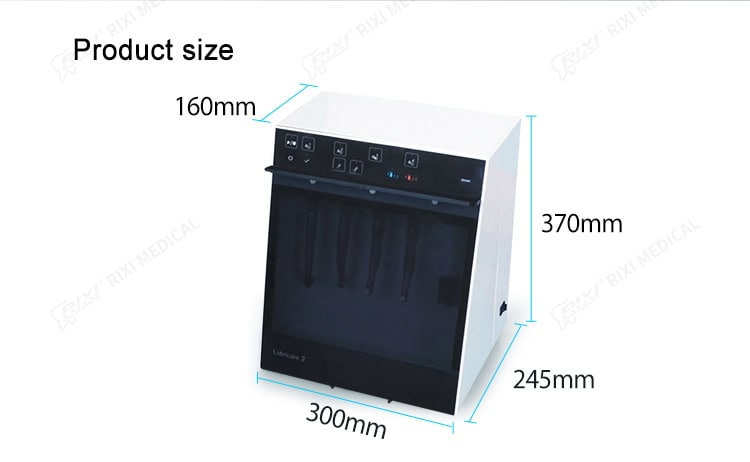
For the RIXI dental handpiece oiling machine, request current product drawings, connection information and a configuration-specific packing list. Product photographs can support review, but they should not replace a drawing or written specification. A visually similar enclosure may still contain a different control panel, port arrangement or power configuration.
Keep model-specific facts separate from general requirements. A buyer may request particular label content, carton marks or manual languages, while the manufacturer must confirm which technical options are available for the selected unit. Unresolved items should remain visibly open rather than being filled with assumptions.
Separate technical approval from brand artwork
OEM projects often combine two approval streams that should be controlled separately. Technical approval covers the machine configuration, connections, utilities, accessories and documents. Brand approval covers logos, colours, labels, carton graphics and the presentation of the manual. A correct logo does not prove that the technical file is correct, and an approved sample does not authorize an unreviewed artwork revision.
| File or record | Buyer checks | Release evidence |
|---|---|---|
| Configuration sheet | Model, voltage, plug, ports, adapters and lubricant interface | Signed or otherwise traceable approval |
| Dimensional drawing | Overall size, opening clearance, connection locations and service access | Drawing number and revision |
| Nameplate and rating label | Model identity and values supplied by the manufacturer | Approved artwork proof linked to the configuration |
| Logo and appearance proof | Placement, colour, size and orientation | Dated digital proof or sample photo |
| Carton and packing list | Shipping marks, accessories, quantities and document language | Approved carton proof and packing-list revision |
| Manual set | Correct model, controls, connections, warnings and service contact | Controlled PDF revision |
Artwork files should be supplied in an agreed format with fonts, colours and dimensions defined. The buyer should also approve a rendered proof showing the artwork on the actual product surface. If the available printable area changes, the manufacturer should return a revised proof instead of resizing a logo without review.
Use sample approval to close specific questions
A sample is useful only when it represents a documented configuration. Before evaluation, attach the configuration sheet, artwork revision and accessory list to the sample record. Photograph the nameplate, control panel, connection area, supplied adapters, outer carton and included documents. Record deviations instead of treating them as verbal exceptions.
Review the sample in two stages. First, confirm identity and presentation: finish, labels, manual, carton and included accessories. Second, complete a controlled functional check using the supplier’s instructions and compatible test items. The separate oiling machine acceptance checklist provides a receiving and commissioning record for utilities, adapters and unresolved issues.
Do not convert one sample result into a universal compatibility claim. Build a model-by-model handpiece and adapter map, and use the lubricant compatibility guide to document the consumable reference and delivery method. Physical connection alone does not establish that the full combination is approved.
Control packaging as part of the product record
Packaging approval should show how the machine, removable parts, bottles or reservoirs, adapters, power accessories and documents are arranged. Confirm which parts are installed, bagged separately or placed in an accessory box. A packing list should use the same references as the purchase order and configuration sheet.

For export orders, ask which shipping marks and document copies are required by the buyer, carrier or destination-side partner. Requirements vary by product and jurisdiction, so avoid copying a previous shipment’s labels without review. If a carton, foam insert or accessory layout changes, confirm whether the change affects dimensions, protection or the receiving checklist.
RIXI Medical operates as a dental equipment manufacturer and supplier in Foshan, China. OEM/ODM buyers can use its quality-control information as a starting point for discussing inspection records, while the purchase agreement should define the evidence required for the specific order.
Prevent silent substitutions with change control
A supplier may need to change an adapter reference, cable, bottle format, label material or carton layout. The issue is not that every change is unacceptable; the risk is that a change reaches production without the right review. Define which changes require notification and which party can approve them.
A change notice should identify the affected item, reason, old and new revision, orders or serial ranges affected, and any related updates to manuals, drawings, packing lists or service parts. Keep the previous approved file with the order history. Do not overwrite it with a new version that makes the original delivery impossible to reconstruct.
Before repeat production, issue a release pack containing only the current approved files. The production team should not have to choose between several similarly named PDFs. A concise release index reduces the chance that an old label or manual is reused.
Plan service documents and repeat orders at launch
Private-label support becomes difficult when the distributor’s commercial code cannot be linked to the manufacturer’s machine and parts records. Create a cross-reference between the buyer’s SKU, the underlying model, compatible adapters, consumables and replaceable accessories. State which items are included initially and which have separate reorder references.
The handover pack should include the final configuration sheet, drawings, artwork approvals, manual revision, packing list, sample exceptions, production-release index and support contact. Ask which information the supplier needs for a service enquiry—such as model identification, order reference, photos or an error indication—and include that route in distributor training.
Use the broader dental handpiece equipment range to map related models and connections, but confirm exact compatibility in writing. The technical support page can help buyers locate general service information; transaction-specific warranty scope, response times and parts availability must come from the written agreement.
Frequently asked questions
Should the logo proof and technical drawing use the same revision number?
They may use separate numbering systems, but the release index should clearly link the approved artwork to the correct technical configuration and production order.
Is a digital artwork proof enough for production approval?
It can approve layout and content, but the buyer should decide whether colour, surface position or print quality also requires a physical sample or production photo.
What should happen when an adapter changes?
The supplier should identify the old and new references, affected handpiece map, packing list and instructions. The buyer should review the change before it enters a released package.
Can the same manual be used for several private-label models?
Only when it accurately covers each included configuration and clearly distinguishes any differences. Otherwise, use model-specific manuals or controlled supplements.
Reviewer and scope note: This is general OEM/ODM documentation guidance. Confirm exact specifications, compatibility, label content and destination-market obligations with the supplier and locally qualified professionals before production or installation.
For a controlled private-label quotation, send RIXI Medical the target market, electrical configuration, handpiece connection list, artwork requirements and requested document languages.
Need Dental Equipment Pricing or Configuration Details?
Contact RIXI Medical for model comparison, distributor pricing, packaging information, OEM/ODM requirements and after-sales support.
Request Product Information