A foot ring changes how a dental stool must be specified, packed and checked. It is not enough to approve a green seat and a polished base from a catalogue image. The buyer needs to know where the ring sits in the finished height range, how it is retained, whether it conflicts with the adjustment mechanism, and which base and caster configuration will arrive.
This guide is for clinics, distributors and procurement teams reviewing a conventional dental stool with a foot ring. It uses the current RIXI product photographs as an identification example. Exact dimensions, materials, load limits and service methods remain model-specific and should be confirmed in the current supplier documents.
Define the complete stool before comparing quotations
A short description such as “adjustable stool with foot ring” can conceal important differences. Ask the supplier to identify the seat assembly, lift or cylinder, foot ring, base, casters, controls and fasteners as one approved configuration. If the order includes several colors, record the color reference separately from the mechanical configuration.
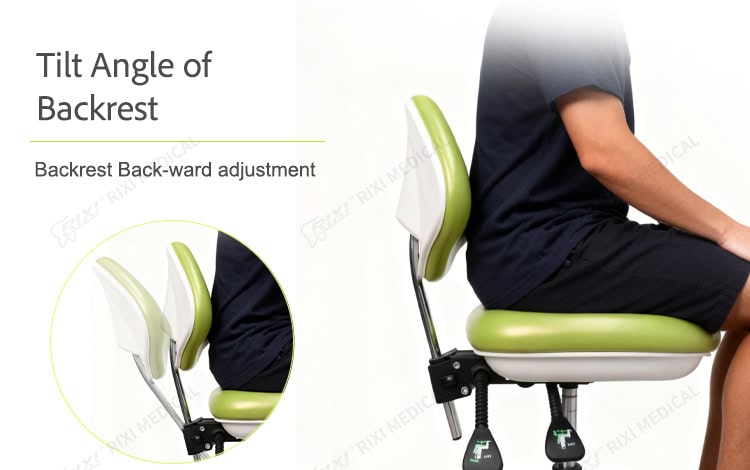
The current RIXI listing shows a green seat, height adjustment, a circular foot ring, a stainless-style base and casters. Those visible features help identify the product family, but they do not establish the ring diameter, finished seat-height range, base material grade or caster stem. Put those items on the quotation or dimension sheet rather than inferring them from the photographs.

Measure the foot ring inside the working envelope
The ring should be reviewed together with the seat-height range. Request the ring’s outside diameter, vertical position, usable foot-contact area and clearance from the column, base and controls. Ask whether the ring position is fixed or adjustable and, if adjustable, how it is locked. A loose description of “foot support” is not a testable specification.
For a sample, have intended users adjust the stool through the documented range and observe whether the ring remains accessible without contacting levers or the caster base. The test should be an equipment-fit review, not a medical or posture assessment. If different lift options are available, repeat the review for the exact lift included in the quotation because the ring-to-seat relationship may change.
Separate the ring connection from the lift mechanism
Ask for an underside or component drawing that shows how the ring connects to the column. Procurement should be able to identify the retaining parts and determine whether installation is completed at the factory or during local assembly. If the stool ships partly disassembled, request the assembly sequence, required tools and tightening instructions for that model.
Do not assume that the ring can be moved, drilled or replaced with a visually similar part. An informal change can affect clearance or interfere with the lift and base. A distributor should keep the accepted ring and column references with the sample record so a later parts request is based on identifiers rather than memory.
Review the base, casters and floor conditions
A foot ring adds another circular element above the base, so the buyer should check both diameters and the clearance between them. Record the base diameter, number of caster points, surface finish and caster type. The product title identifies a stainless base, while the listing describes a stainless-style base; request the current material declaration and finish description if either affects the purchase specification.
Move the sample over a representative clinic floor, around the chair base and beside cabinetry. Check whether shoes, the ring or nearby cables can contact the casters during rotation. If the supplier offers alternative casters, ask for their part references and intended floor conditions. The broader dental stool fit and service guide explains how base footprint, flooring and replacement parts belong in a general stool comparison.
Write a quotation that receiving staff can use
| Order field | Evidence to request | Receiving check |
|---|---|---|
| Seat and color | Seat dimensions, upholstery description, color reference and cleaning guidance | Match color, seams and visible condition to the approved record |
| Lift and controls | Finished height range, measurement points and control map | Operate the documented range and confirm control functions |
| Foot ring | Diameter, position, adjustment method and retaining parts | Check identity, security, clearance and supplied fasteners |
| Base and casters | Base diameter, material/finish, caster type and part references | Inspect for mismatch or transit damage and test movement |
| Packing | Assembly state, carton list, instructions and ordered spares | Reconcile every loose component before assembly |
For multi-unit orders, identify which characteristics may vary and which are controlled. Upholstery color may be an approved option, while the ring diameter, lift, base or caster system may need to match the accepted sample exactly. Record production changes before approving a repeat order.
Use a staged receiving inspection
- Match the model name, color and configuration with the purchase order and packing list.
- Photograph the carton condition and all loose components before assembly.
- Inspect the seat, ring, column, base, casters, controls and visible fasteners for damage or substitution.
- Assemble only according to the current instructions, if local assembly is required.
- Operate the height control through its documented range and confirm that the ring remains secure and clear.
- Move and rotate the stool on a representative floor without using it beyond the supplier’s instructions.
- File the accepted photographs, component references and unresolved exceptions for repeat-order control.
Keep unclear items out of service until the supplier resolves the mismatch. A missing fastener, different caster or undocumented ring connection should be logged against the carton or item rather than corrected by an unapproved local substitution.
Plan service parts and repeat orders
Ask which components are available as service parts and whether a qualified technician is required for replacement. The foot ring, retaining hardware, lift, casters and base should each have a stable description or part reference where they are replaceable. A visually similar ring is not adequate compatibility evidence.
Buyers comparing other conventional formats can review the adjustable dentist stool with swivel base. The full dentist stool range also includes saddle and backrest configurations, which should be treated as separate product families rather than substitutes selected by color alone.
RIXI Medical is a dental equipment manufacturer and supplier in Foshan, China. Its quality-control overview and technical support page can help buyers prepare documentation and service questions. For a model-specific quotation, request the current dimension sheet, option list and parts information through the RIXI Medical inquiry page.
Frequently asked questions
Is the foot ring height adjustable?
Do not assume it is. Ask whether the ring is fixed or adjustable and request the exact locking method for the quoted model.
Does a stainless-looking base confirm the material?
No. Photographs show appearance only. If material or finish matters, request the current supplier declaration for the exact configuration.
Can a clinic replace the ring with a similar part?
Use a supplier-identified replacement or written compatibility confirmation. Similar diameter and appearance do not prove the same connection or clearance.
What should a distributor retain for repeat orders?
Keep the model and quotation revision, dimension sheet, lift and ring configuration, base and caster references, upholstery color, assembly instructions and accepted sample photographs.
Scope note: This is general equipment procurement guidance, not medical or ergonomic advice. Confirm exact specifications with the supplier and involve appropriately qualified local professionals where workplace or technical review is required.
Need Dental Equipment Pricing or Configuration Details?
Contact RIXI Medical for model comparison, distributor pricing, packaging information, OEM/ODM requirements and after-sales support.
Request Product Information