Dental Suction System: Specify the Whole Installation
A suction pump cannot be selected from a product photograph alone. The useful purchase specification connects the equipment to simultaneous chair demand, pipe routing, wastewater handling, electrical or compressed-air supply, ventilation, service access and the party responsible for commissioning.
Clinic owners, distributors and contractors often compare suction equipment by headline power or a supplier’s recommended chair count. Those figures only become meaningful when the operating conditions are defined. Long pipe runs, branch layout, the number of operatories working at once and the chosen separation arrangement can change what the installation requires. A buyer should therefore request a model-specific data sheet and connection drawing before confirming equipment-room construction.

Choose the system architecture before the model
A central motor-driven system can support more than one operatory and may allow noise and service work to be moved away from treatment rooms. A chair-side or mobile unit can simplify a small installation or a temporary room, but it occupies local space and requires a practical route for power, discharge and cleaning. An air-driven arrangement relies on the compressed-air system, so its demand must be reviewed together with compressor capacity.
The handling of air, liquid and solids also matters. Some installations separate liquid before it reaches the pump; others depend on a different wet or dry arrangement. Buyers should not infer this from the cabinet shape. Ask the supplier to show the intended flow path, the position of traps or separators, the drain connection and the components that require routine access.
| Architecture | Useful when | Questions to resolve |
|---|---|---|
| Central motor-driven system | Several operatories share one utility area | Simultaneous demand, main and branch sizing, separation method, ventilation, standby plan and service isolation |
| Chair-side or mobile unit | A small clinic, additional room or temporary setup needs local support | Footprint, noise, heat, discharge route, cleaning access, movement and cable or hose management |
| Air-driven arrangement | The selected chair or project uses compressed air to create suction | Required pressure and flow, compressor reserve, air quality, operating cost and performance under concurrent use |
This comparison is a starting framework, not a model specification. Confirm the actual architecture and permitted applications for the quoted equipment.
Build a quotation around measurable inputs
A supplier can make a more useful recommendation when the enquiry describes the project. State the number of installed chairs, the maximum number likely to use suction simultaneously, the planned expansion allowance and whether the system is new or must connect to existing pipework. Include a room plan with equipment location, approximate pipe lengths, changes in elevation and proposed branch points.
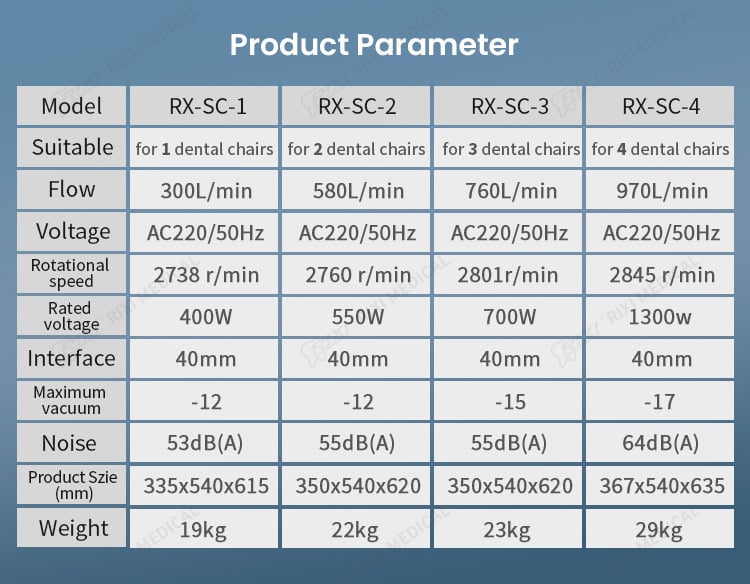
For the quoted model, request the rated electrical input or compressed-air requirement, intended simultaneous capacity, inlet and outlet size and location, permitted pipe arrangement, drain and separator requirements, overall dimensions, operating clearance and recommended ventilation. Ask for stated performance under the supplier’s defined test conditions rather than comparing isolated headline numbers from unrelated data sheets.
- Exact model code and approved configuration
- Connection and dimensional drawing with revision date
- Electrical, air, drain and ventilation requirements
- Inlet, outlet, trap and separator arrangement
- Operating and service clearances
- Filter, seal, trap and other maintenance items
- Installation, operation and maintenance documents
- Packing list, spare-parts list and service contact
Protect performance through pipe and room planning
Even a suitable pump can underperform if the system around it is poorly coordinated. Avoid treating the suction route as leftover space after cabinetry and flooring are fixed. Excessive bends, unintended restrictions, inaccessible low points and branches that cannot be isolated can make commissioning and later maintenance harder. The contractor should work from the current supplier drawing and document any approved deviation.
The equipment room also needs a serviceable layout. Leave access to covers, filters, traps, electrical isolation and drain points. Provide the ventilation or heat-management arrangement specified for the selected model. Keep the unit away from areas where stored goods, cleaning materials or packaging would block inspection. If the project depends on uninterrupted availability, agree a contingency plan instead of assuming that one machine can be serviced without affecting the clinic.
Separate the product order from the installation scope
The equipment supplier, local contractor and commissioning technician may each own different tasks. Record who supplies the connection fittings, who verifies the pipework, who provides electrical protection, who starts the unit, and who signs the acceptance record. If responsibilities are not written down, a missing adapter or unsuitable drain route can become a dispute after delivery.
RIXI Medical is a dental equipment manufacturer and supplier based in Foshan, China. For the current dental negative-pressure suction pump, buyers should request the latest model data and packing list rather than treating the guidance on this page as a fixed specification. The broader dental suction equipment category provides the relevant product cluster.
Inspect the delivery and record commissioning
Receiving inspection should confirm the model identity, labels, quantity, visible condition and included components against the purchase order. Check that manuals, drawings and packing documents refer to the delivered version. Do not energize equipment with transport damage, an uncertain electrical configuration or incomplete connections.
A qualified technician should commission the installed system using the model instructions. The record should identify the configuration, verify connection integrity, note operating observations under the agreed demand scenario, and list any unresolved exception with an owner and due date. Keep the signed record with the approved drawings, serial information and maintenance schedule. The related dental utility-room handover guide explains how suction and compressed air fit into the wider plant-room package, while the dental chair plumbing guide covers operatory-side water, drain and suction coordination.
Frequently asked questions
Can a dental suction system be sized by chair count alone?
No. Chair count is only one input. Simultaneous use, system architecture, pipe layout, separation method and the model’s stated operating conditions must also be reviewed.
What drawing should a buyer request before installation?
Request the current connection and dimensional drawing for the exact model and configuration. It should identify utility points, inlet and outlet details, clearances and any model-specific installation notes.
Should the pump be enclosed inside cabinetry?
Only when the selected model’s instructions allow it and the design preserves ventilation, heat management, isolation and maintenance access. Decorative concealment must not block routine service.
What should be included in a distributor package?
Confirm the exact unit, standard fittings, optional adapters, manuals, drawings, packing list, replaceable maintenance items, spare-parts route and the division of installation and commissioning responsibilities.
For supporting utility planning, review the oil-free dental air compressor sizing guide. Technical questions can be routed through RIXI technical support.
Request a model-specific suction package
Send RIXI Medical the planned chair count, simultaneous-use assumption, room drawing, destination market and preferred system arrangement to request specifications, connection drawings and an itemized quotation.
Request specifications and drawingsNeed Dental Equipment Pricing or Configuration Details?
Contact RIXI Medical for model comparison, distributor pricing, packaging information, OEM/ODM requirements and after-sales support.
Request Product Information