A compressor quotation can look reassuringly simple: motor power, tank volume, pressure and price. The problems usually appear later, when several treatment rooms call for air at once, the utility room runs hot, or a technician discovers that the dryer cannot be reached without moving other equipment. At the chair, those planning gaps may show up as pressure fluctuation, excess moisture, distracting noise or avoidable downtime.
For a new clinic, renovation or distributor project, “How many horsepower do we need?” is therefore the wrong opening question. Start with the clinic’s working pattern: which instruments use air, how many may run together, where the compressor will sit and who will maintain it. Those details give meaning to the dental air compressor specifications on a data sheet.
Editorial scope: This guide is written for clinic owners, contractors, distributors and procurement teams preparing a technical enquiry. It does not replace model manuals, local electrical or pressure-vessel requirements, or an installation plan prepared by qualified professionals.
Start with simultaneous demand, not chair count alone
Two four-chair clinics can place very different demands on a compressor. A busy hygiene and restorative schedule may keep three rooms active at the same time; a specialist clinic may rarely operate more than one. Air-driven handpieces, chair controls, scalers and laboratory devices also draw air in different bursts. A chair count on its own does not capture that behavior.
Ask the supplier to size the system against the maximum realistic number of devices operating simultaneously. Provide a simple equipment schedule listing each dental unit, the air-powered instruments connected to it, expected overlap and any planned expansion. If the clinic may add two operatories later, discuss that now. Oversizing can increase purchase cost, footprint and cycling inefficiency, while undersizing may create pressure drops during busy periods.
For a wider view of plant-room coordination, see our dental utility room equipment planning guide. Compressor selection should be coordinated with suction, electrical distribution, ventilation and maintenance access rather than treated as an isolated purchase.
Dental air compressor specifications worth comparing
| Specification | Why it matters | What to confirm |
|---|---|---|
| Free air delivery | Indicates usable air output more clearly than motor power alone | Rated delivery at the required operating pressure, not only theoretical displacement |
| Operating pressure | Must remain within the dental units’ specified inlet range | Cut-in and cut-out settings, regulator range and pressure stability under load |
| Receiver volume | Affects reserve capacity and compressor cycling | Tank size, drain method, inspection access and local compliance requirements |
| Air treatment | Moisture can affect instruments, valves and air quality | Dryer type, filtration stages, drain arrangement and service intervals |
| Noise level | Influences where the unit can be installed | Test conditions, cabinet configuration and ventilation needs |
| Electrical input | Determines compatibility with the site supply | Voltage, frequency, phase, rated current, start-up load and protection |
| Duty and redundancy | Relates to peak use and continuity of service | Permitted duty cycle, number of pump heads and operation if one module is offline |
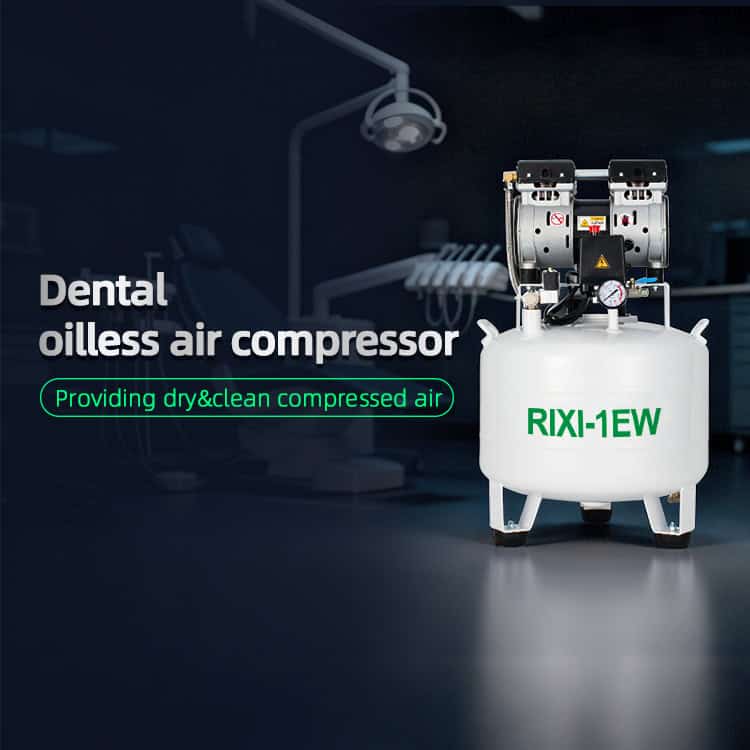
Do not compare quotations by one headline number. In supplier discussions, ask where the stated airflow was measured, at what pressure, and whether the figure describes theoretical displacement or usable delivery. Also check whether the illustrated cabinet, dryer, filters and receiver are included in the quoted configuration. These checks often explain why similar offers are not equivalent. Model-specific performance must still be confirmed on the final data sheet.
Oil-free design and air quality
Dental applications generally call for an oil-free compression path so lubricant is not introduced into the supplied air. “Oil-free,” however, does not mean the air is automatically dry or that filtration can be ignored. Ambient humidity, receiver condensation, dryer performance, intake location and maintenance all affect the delivered air.
Request an air-path diagram showing the compressor heads, after-cooling or drying components, filters, receiver, drains and outlet. Ask which consumables require replacement and how technicians access them. Buyers comparing an oil-free dental air compressor should also confirm whether the listed configuration includes the dryer and acoustic cabinet or whether these are optional.

Pressure is a compatibility requirement
The compressor must supply adequate pressure after allowing for regulators, filters, dryers, pipe losses and simultaneous demand. More pressure is not automatically better. Excessive inlet pressure can conflict with the dental unit manufacturer’s specification and adds stress to the system.
Collect the permitted air inlet range from each connected device, then ask the installer to calculate expected pressure at the furthest outlet during peak demand. The dental chair power and utility guide helps procurement teams coordinate these requirements before the floor and walls are closed.
Plan the room around heat, noise and service access
A compressor converts electrical energy into both compressed air and heat. A cabinet may reduce perceived noise, but it does not remove the need for ventilation. Crowding a compressor into a sealed cupboard can raise operating temperature and shorten component life. Likewise, locating it beside a dusty workshop process or chemical storage area can compromise intake conditions.
Ask for the required clearances around the cabinet, allowable ambient temperature range, airflow direction and heat-rejection information. Mark the position of doors and removable panels on the room layout so filters, pump heads and electrical components can be reached without dismantling surrounding equipment.
Drainage also deserves a decision before installation. Determine how condensate leaves the dryer and receiver, whether drains are automatic or manual, and where discharge is permitted under local rules. Coordinate pipe routes and isolation points with the recommendations in the dental chair plumbing guide.
Before approving the room drawing
Mark more than the compressor footprint. The drawing should show the service side, door swing, air intake, warm-air discharge, drain route, electrical isolator, outlet connection and enough working space for a technician. If the receiver or dryer must be removed through a doorway, check that route too. Include a dimensioned elevation as well as the floor plan.
Ask the supplier to identify every connection on the drawing and state what is supplied loose for site installation. The contractor should then confirm pipe material, isolation valves, pressure regulation and the route to the furthest chair. This handoff prevents a common procurement gap: the equipment supplier assumes the installer will provide an item, while the installer assumes it comes with the machine.
A practical RFQ checklist for clinics and distributors
A useful request for quotation should make the operating assumptions visible. Include:
- Current number of treatment rooms and the planned expansion capacity.
- Maximum number of dental units expected to run simultaneously.
- List of other devices that will use compressed air.
- Required pressure range at each dental unit or device.
- Available voltage, frequency, phase and electrical protection.
- Utility-room dimensions, ventilation arrangement and allowable noise at adjacent rooms.
- Maximum pipe run, proposed pipe material and furthest outlet.
- Required dryer, filtration, receiver and condensate-drain configuration.
- Preferred redundancy strategy and acceptable service interruption.
- Needed documents: dimensional drawing, connection diagram, data sheet, maintenance schedule, spare-parts list and packing details.
For distributor or OEM/ODM projects, add the target market, labeling language, plug or connection requirements, packaging constraints and expected spare-parts support. RIXI Medical is a dental equipment manufacturer and supplier in Foshan, China. When contacting our team, send the room count, simultaneous-use estimate, local power supply and installation-space dimensions. That information allows a more useful configuration discussion than a request based only on chair quantity.
Buyers can review the dental air compressor range or request specifications and drawings. For a distributor quotation, include the destination market and any OEM/ODM labeling or packaging requirements.
Questions to settle before purchase
How many dental chairs can one compressor support?
There is no reliable universal ratio. The answer depends on usable air delivery at pressure, simultaneous instrument demand, receiver capacity, pipe losses and the supplier’s duty assumptions. Give the supplier an equipment and concurrency schedule.
Is motor horsepower enough to compare compressors?
No. Motor rating does not state how much usable air reaches the clinic. Compare free air delivery at the required pressure, duty conditions, air treatment and electrical demand.
Does an oil-free compressor still need a dryer?
Oil-free describes the compression path; it does not remove moisture from ambient air. The need and type of drying depend on climate, equipment requirements and the selected configuration.
Should a clinic choose a larger receiver?
A larger receiver can provide reserve and reduce short cycling in some installations, but it also adds space and inspection considerations. It should be sized with compressor output and demand, not selected in isolation.
What should be checked before installation?
Confirm the electrical supply, ventilation, service clearance, intake conditions, drainage, outlet pressure regulation, pipe routing and connection sizes. Have the supplier and local qualified installer review the final drawings before work begins.
Scope note: This article provides general procurement and planning guidance. Exact performance, installation requirements and compliance obligations vary by model and location; confirm them with the equipment supplier and appropriately qualified local professionals.
Need Dental Equipment Pricing or Configuration Details?
Contact RIXI Medical for model comparison, distributor pricing, packaging information, OEM/ODM requirements and after-sales support.
Request Product Information