
Cast Aluminum Dental Chair Base: What OEM Buyers Should Evaluate
A dental chair base is more than a cosmetic cover. Its geometry, alloy control, casting quality, machining accuracy and surface finish influence stability, service life and the consistency of final assembly.

For an aluminum die casting dental chair OEM project, buyers should review the component as part of a controlled manufacturing system. RIXI Medical is a dental equipment manufacturer and supplier in Foshan, China, working with distributors, clinic groups and OEM/ODM partners on dental chair configurations.
Why cast aluminum is used in dental chair structures
Cast aluminum can combine structural rigidity with repeatable geometry and a clean finished appearance. It also supports integrated mounting points and complex shapes that would require multiple welded parts in another construction method. The result depends on engineering and process discipline; the material name alone does not prove quality.
Structural design
Load paths, wall thickness, ribs and mounting points should be engineered for the complete chair rather than copied from appearance alone.
Process consistency
Controlled melting, mold conditions and casting parameters help reduce porosity, incomplete filling and dimensional variation.
Finish protection
Surface preparation and coating quality influence corrosion resistance, visual consistency and cleaning durability.
Questions to include in an OEM technical review
| Review area | Evidence to request | Buyer objective |
|---|---|---|
| Alloy specification | Declared material grade and incoming-material control | Consistent mechanical and finishing behavior |
| Casting control | Process inspection points and defect criteria | Reduce porosity, cracks and incomplete features |
| Machining | Critical dimensions and tolerance plan | Reliable fit with columns, motors and covers |
| Surface treatment | Preparation, coating method and appearance standard | Durable finish suitable for clinical cleaning |
| Assembly testing | Stability, movement and load-test procedure | Verify performance of the complete chair |
| Traceability | Batch and inspection records | Support quality investigation and repeat orders |
Evaluate the complete chair, not only the base
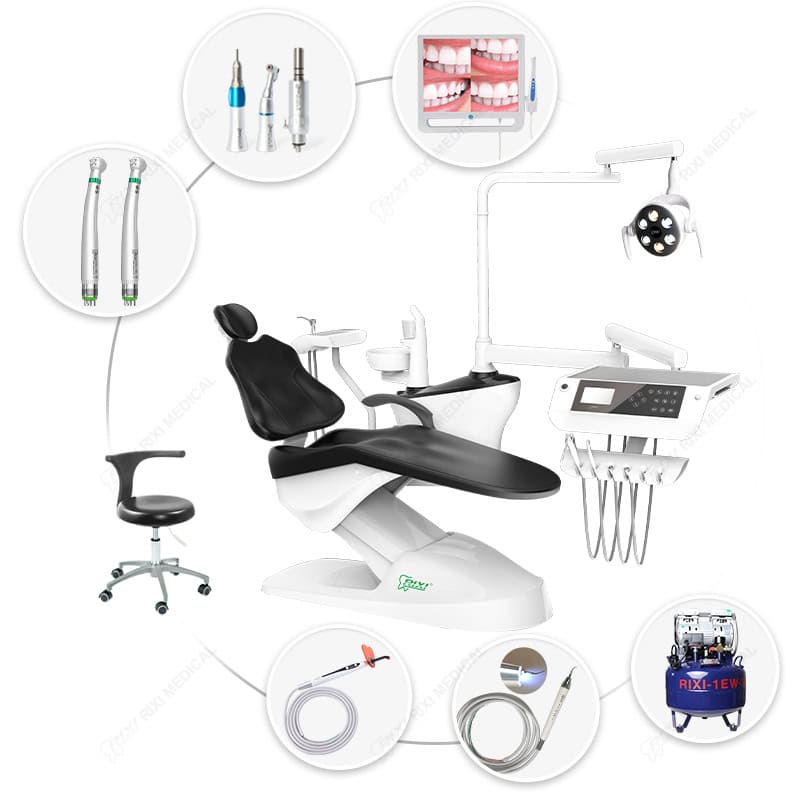
The base interacts with the lifting system, seat frame, backrest, delivery unit and operating light. A visually attractive casting is not enough if hole positions vary, fasteners are difficult to service or movement introduces play. Ask the manufacturer how the chair is checked after final assembly and how critical components remain accessible during maintenance.
For comparison, review the configuration of the R5 advanced dental chair and the R1 integrated dental chair. These product pages help buyers discuss complete-unit requirements instead of treating a structural part in isolation.
From sample approval to production order
- Define the product brief: target market, voltage, chair functions, upholstery, color, logo placement and required documentation.
- Approve drawings and specifications: identify critical dimensions and interfaces before tooling or configuration changes.
- Review a complete sample: inspect finish, movement, noise, stability, controls, accessories and packaging.
- Agree on inspection criteria: document acceptable appearance, functional tests and sampling method.
- Control changes: require written approval before materials, components or production methods are changed.
- Confirm after-sales support: establish spare-parts identification, manuals, installation support and warranty procedure.
OEM customization beyond the metal structure
Distributor projects may also require upholstery colors, control-panel language, logos, cartons, manuals and accessory packages. These choices should be recorded in one approved configuration sheet. Avoid managing important details only through chat messages, because production and quality teams need a controlled reference.
Supporting items can be planned at the same time. A split saddle dental stool and dental storage cabinet can help distributors offer a coordinated operatory package. Browse the dental chair category for available configurations.
Frequently asked questions
Does cast aluminum automatically mean a stronger dental chair?
No. Strength and stability depend on alloy selection, geometry, casting quality, machining, assembly and verification of the finished unit.
What should an OEM buyer approve before mass production?
Approve the technical specification, visual sample, critical dimensions, functional tests, packaging, labeling and change-control process.
Can distributors request private branding?
Branding and configuration options depend on quantity and project scope. Buyers should provide market requirements early so feasibility can be confirmed before sample approval.
Discuss a dental chair OEM project
Send RIXI Medical your target market, configuration, quantity and branding requirements to request technical details and an OEM/ODM quotation.
Contact RIXI MedicalNeed Dental Equipment Pricing or Configuration Details?
Contact RIXI Medical for model comparison, distributor pricing, packaging information, OEM/ODM requirements and after-sales support.
Request Product Information
