
Dental Chair Power Requirements: Plan Utilities Before Installation
A dental chair can only perform reliably when its electrical supply, compressed air, clean water and drainage are planned as one system. This guide helps clinic owners, project contractors and distributors prepare an operatory before delivery.
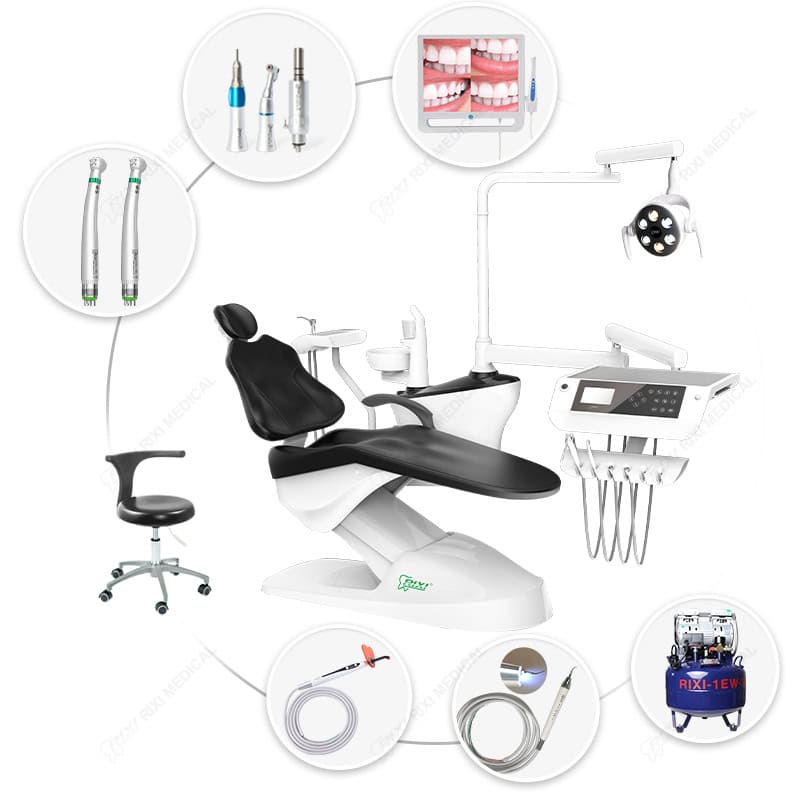
Dental chair power requirements vary by model and configuration. Before construction begins, request the technical installation drawing for the exact chair being ordered. RIXI Medical supplies dental chair units from Foshan, China and supports clinics, hospitals, distributors and project buyers with model-specific utility information.
Five services every dental operatory must coordinate
1. Electrical supply
Confirm rated voltage, frequency, plug type, maximum power and grounding. A dedicated circuit with appropriate protection helps reduce interruptions from other equipment.
2. Compressed air
Stable, clean and dry air supports handpiece performance and pneumatic controls. Plan compressor capacity for the number of chairs operating at the same time.
3. Clean water
Check inlet pressure, filtration and local water quality. Where bottle systems are used, allow space for filling, cleaning and routine inspection.
4. Drainage and suction
Drain gradients, pipe diameter and suction configuration affect evacuation performance. Keep service access available instead of sealing all connections permanently.
5. Data and accessories
Plan outlets and cable routes for monitors, intraoral cameras, X-ray sensors and other chair-side devices without creating trip hazards.
Electrical planning checklist
The equipment label and manufacturer documentation are the final authority for voltage and load. Do not assume that every chair has identical requirements. Ask the supplier to confirm whether the ordered configuration is 110 V or 220 V, 50 Hz or 60 Hz, and whether optional accessories change the total load.
| Item to confirm | Why it matters | Who should verify it |
|---|---|---|
| Voltage and frequency | Must match the clinic’s local electrical supply and ordered chair configuration. | Supplier and licensed electrician |
| Dedicated circuit | Reduces nuisance trips and interference from high-load equipment. | Electrical contractor |
| Protective grounding | Supports electrical safety and reliable operation. | Licensed electrician |
| Outlet location | Prevents stretched cables and keeps the service area accessible. | Clinic planner and installer |
| Backup strategy | Helps protect electronics where voltage quality is unstable. | Electrical engineer |
Above-floor or concealed utility connections?
Concealed floor boxes provide a clean appearance, but their position must be accurate. Above-floor connections can simplify retrofit projects and future maintenance. The correct choice depends on the building, chair base design, service access and local construction practice.
Before concrete, flooring or cabinetry is completed, mark the chair centerline, base footprint, patient entry path and clinician working zones. Also check door swing, cabinetry clearance and the movement envelope of the backrest, delivery arm and operating light.

Compressed air and suction sizing
A compressor should be selected for simultaneous demand, not only the number printed on the clinic floor plan. Consider chair count, expected procedures, duty cycle, future expansion and whether other devices share the air supply. Air treatment and routine draining are also important because moisture and contamination can shorten component life.
For suction, confirm whether the chair package uses an air-driven, water-driven or central suction arrangement. Central systems require coordinated pipework and equipment-room planning. Ask about expected flow, line routing, maintenance access and separation from clean-water services.
Pre-delivery site acceptance checklist
- The exact chair model and configuration match the approved quotation.
- Voltage, frequency and plug or hardwire method have been confirmed in writing.
- Air, water, drain and suction points match the supplier’s installation drawing.
- The finished floor is level and suitable for the chair’s anchoring method.
- Technicians can reach shut-off valves, filters and service connections.
- Doorways, lifts and corridors can accommodate packaged equipment.
- Installation, commissioning and staff handover responsibilities are assigned.
Choose equipment around the complete room
Chair selection should also account for operator seating and digital workflow. An ergonomic dental saddle stool supports positioning, while a USB dental X-ray sensor requires a practical computer and cable location. Browse the complete dental chair range or view all RIXI Medical products.
Frequently asked questions
Can one electrical specification be used for every dental chair?
No. The ordered model, regional configuration and accessories determine the final requirement. Always use the technical sheet supplied for the exact unit.
When should utility points be installed?
They should be coordinated before floor and cabinetry work is finalized. Final connection and commissioning should follow the manufacturer documentation and applicable local rules.
What information should a buyer send the supplier?
Provide the destination country, clinic voltage and frequency, room drawing, chair quantity, suction plan, optional accessories and requested installation date.
Request a model-specific installation drawing
Contact RIXI Medical for dental chair specifications, utility drawings, configuration advice, distributor pricing and OEM/ODM project support.
Contact RIXI MedicalNeed Dental Equipment Pricing or Configuration Details?
Contact RIXI Medical for model comparison, distributor pricing, packaging information, OEM/ODM requirements and after-sales support.
Request Product Information
