A sensor holder that looks suitable in a catalogue can still be a poor match for the sensor delivered to a clinic. Housing thickness, corner shape, cable exit and the protective sheath can all affect how the parts fit together. The purchasing decision is therefore a matched accessory set, not simply a holder labelled “universal.”
This guide helps clinic buyers and distributors evaluate dental X-ray sensor holders before approving a sample or repeat order. It concentrates on physical compatibility and supply documentation. For the wider hardware decision, use the separate USB sensor comparison guide.
Start with the sensor housing, not the size label
Ask for the external length, width and thickness of the exact sensor version, together with a drawing or clear views of its back and cable junction. An active imaging area describes a different feature; it does not establish the space needed inside a holder. Two devices sold under the same nominal size can require different physical support.
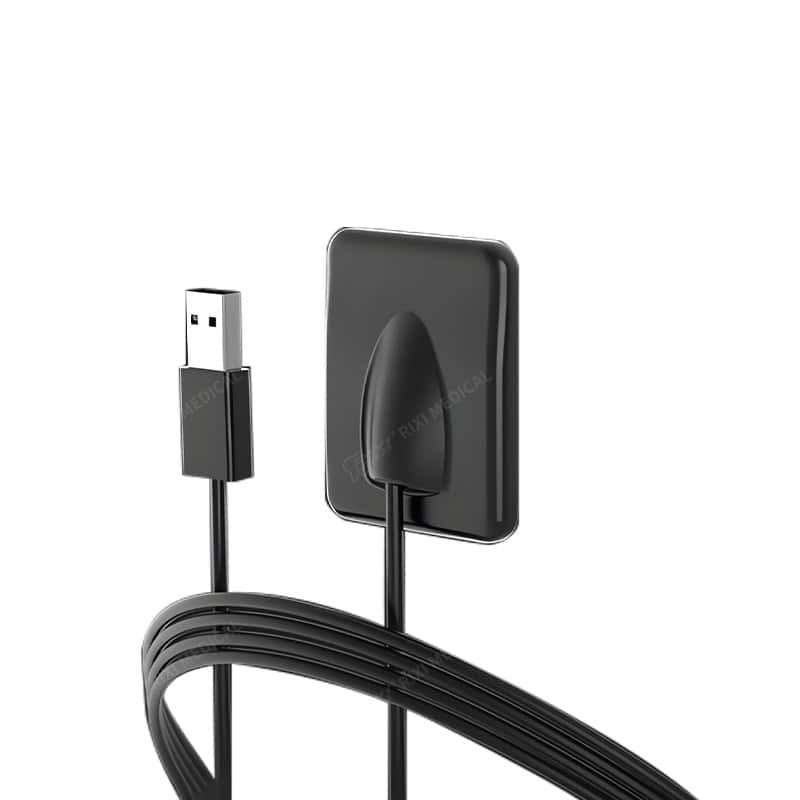
When requesting a quotation for a USB dental X-ray sensor package, identify the proposed holder manufacturer, model and accessory reference. Ask whether the holder is included, optional or locally sourced. A product photograph should never replace an itemized packing list.
Compare the complete assembly
Separate the sensor support, positioning arm, aiming ring and any disposable or replaceable element in the proposed set. Record the references that belong together. Similar colours or interchangeable-looking joints are insufficient evidence that components from different systems can be mixed.
Manufacturer catalogues illustrate why the assembly matters. Dentsply Sirona lists different application-specific components within its Rinn XCP-DS Fit range. That is an example of a named accessory system, not a compatibility endorsement for a RIXI sensor. Request confirmation for the actual combination being purchased.
| Interface | Evidence to request | Reason to pause approval |
|---|---|---|
| Sensor and support | Housing dimensions and the holder’s supported models or adjustment range | The sensor needs force, rocks or cannot be removed as instructed |
| Cable exit | Photos of the seated sensor and cable route | A retaining edge presses on the junction or traps the cable |
| Protective sheath | Approved sheath reference and a fit check using it | The assembly fits bare but strains or tears the sheath |
| Arm and aiming components | Matching part references and assembly instructions | Substituted parts cannot be identified or their fit is uncertain |
| Reuse or disposal | Instructions for each component and replacement criteria | A seller gives one generic care instruction for the entire kit |
Include the sheath and cable in sample acceptance
A useful non-clinical sample check uses the exact sensor, holder and protective sheath proposed for the order. Ask the supplier to demonstrate assembly and removal according to the instructions, without forcing the housing or using the cable as a handle. Photograph the seated position and any contact around the cable junction.
Cable handling is a practical purchasing concern. Carestream’s model-specific RVG instructions explicitly warn against pulling the sensor by its cable when removing its protection. For a different sensor, obtain that manufacturer’s own handling instructions rather than treating another brand’s manual as transferable.
Record snagging, unexpected pressure, movement and difficulty releasing the sensor as unresolved compatibility questions. Stop the evaluation if the parts appear to risk damage. A dentist or other appropriately qualified clinical user should separately assess clinical suitability under local procedures; procurement photographs cannot establish positioning performance.

Keep reprocessing responsibilities component-specific
A reusable holder, disposable support, sensor body and protective sheath may have different instructions. Obtain the current instructions for each item and have the clinic’s responsible infection-control personnel review them before purchase. Do not infer that the sensor can undergo a process described for its holder, or that a protective barrier replaces the sensor’s specified care.
For reusable accessories, request the permitted processing method, inspection criteria and any stated service-life limits from their manufacturer. Use only the process parameters and reuse limits specified for that accessory. For disposable items, identify the replacement reference and pack quantity. Confirm how the clinic will distinguish components with different requirements during storage and handover.
Make replacement orders repeatable
Create an accessory compatibility record alongside the imaging equipment specification. Include sensor model and revision, holder and arm references, sheath reference, approved sample date, photographs and the instructions reviewed. Keep open questions visible rather than marking an untested combination approved.
For distributors, list replacement holders, rings, arms and consumables separately where they are available. Agree whether a supplier may substitute a material, retaining feature or component reference. A visually similar replacement should return to sample review if the approved fit or care instructions may change.
When checking dental accessory sourcing options, confirm availability rather than assuming every holder illustrated online is stocked. The quotation should distinguish a replacement component from a complete kit and state what the buyer will receive.
Resolve uncertainties before the order
Send the supplier a concise request: sensor identity, holder reference, housing drawing, cable-junction photos, sheath details and the intended replacement quantity. Ask for a written compatibility response or a clearly defined sample evaluation. Keep any claimed third-party compatibility tied to the exact models and source of that claim.
Use the technical support enquiry checklist when reporting a fit issue. Show the complete assembly and the contact point, with no patient information. State what was observed; avoid attempting to reshape, glue or modify a holder to accommodate an unresolved mismatch.
Buyer questions
Does “universal” mean a holder fits every sensor?
Treat it as a claim to verify for the named holder. Confirm its supported models or dimensional range, then check the exact sensor, sheath and assembly supplied.
Is nominal sensor size enough for ordering accessories?
No. Request external dimensions, housing shape, cable-exit details and the holder reference. The active imaging area alone is not a fit specification.
Can a reusable holder and sensor share one processing instruction?
Do not assume so. Review each manufacturer’s instructions separately with the clinic’s responsible personnel before approving the combination.
What should an approved sample record contain?
Record the sensor version, component references, sheath, instructions, fit observations, photographs and unresolved questions. Use that record to control replacements and substitutions.
Procurement scope: This is general supplier-side guidance, not clinical positioning or reprocessing advice. Confirm all dimensions, compatible accessories and care methods for the actual models. Local qualified professionals should assess clinical suitability and applicable requirements.
RIXI Medical is a dental equipment manufacturer and supplier in Foshan, China. To review a sensor accessory package, request model drawings, included-item details and sample availability.
Need Dental Equipment Pricing or Configuration Details?
Contact RIXI Medical for model comparison, distributor pricing, packaging information, OEM/ODM requirements and after-sales support.
Request Product Information