A compact treatment room can fit a dental chair on a floor plan and still fail in daily use. The delivery arm may block a cabinet, the assistant may have no clear route around the chair, or a service panel may face a wall. Before choosing a chair for a small operatory, buyers should test the complete working envelope, not just the base dimensions shown in a brochure.
This guide is for clinic owners, procurement teams and distributors comparing dental chair configurations for a constrained room. It explains what to measure, what to request from suppliers and how to record unresolved choices before construction or purchasing is finalized.
Draw the room around movement, not a product silhouette
Begin with an accurate room drawing that identifies doors, cabinetry, plumbing points, electrical outlets and fixed equipment. Mark the actual swing of every door and drawer. Then add the proposed chair footprint in several positions: upright, fully reclined and the positions used for entry and exit. A drawing that shows only one pose misses the moments when space is most limited.
Ask the supplier for a dimensioned plan of the exact chair and delivery configuration being quoted. It should show base dimensions, full chair travel, headrest adjustment, light and instrument-arm movement, and the access needed to remove service panels. Generic catalog dimensions are a starting point, not a substitute for a model-specific drawing.
Include the dentist’s and assistant’s stools as moving objects. The route from doorway to chair, the route to handwashing and the route to storage should remain usable when someone is seated. A local designer or installer should confirm required clearances and accessibility rules for the destination. This article does not prescribe a universal minimum room size.
Compare delivery layouts in the actual room
Delivery style changes the area a buyer must reserve around the chair. An over-the-patient arrangement may keep instruments close to the working position, but its arm still needs a clear travel path. A side-delivery arrangement can conflict with cabinetry or a narrow aisle. A rear-delivery arrangement calls for careful planning behind the head of the chair. None is automatically the smallest solution.
Request both a top view and a side view of the selected configuration. Mark instrument-arm reach, tubing paths, lamp movement and the positions where a clinician or assistant will sit. If the room has a column, angled wall or low cabinet, model that obstruction at its real height. A simple cardboard or taped floor mock-up can reveal a collision that a flat drawing hides.
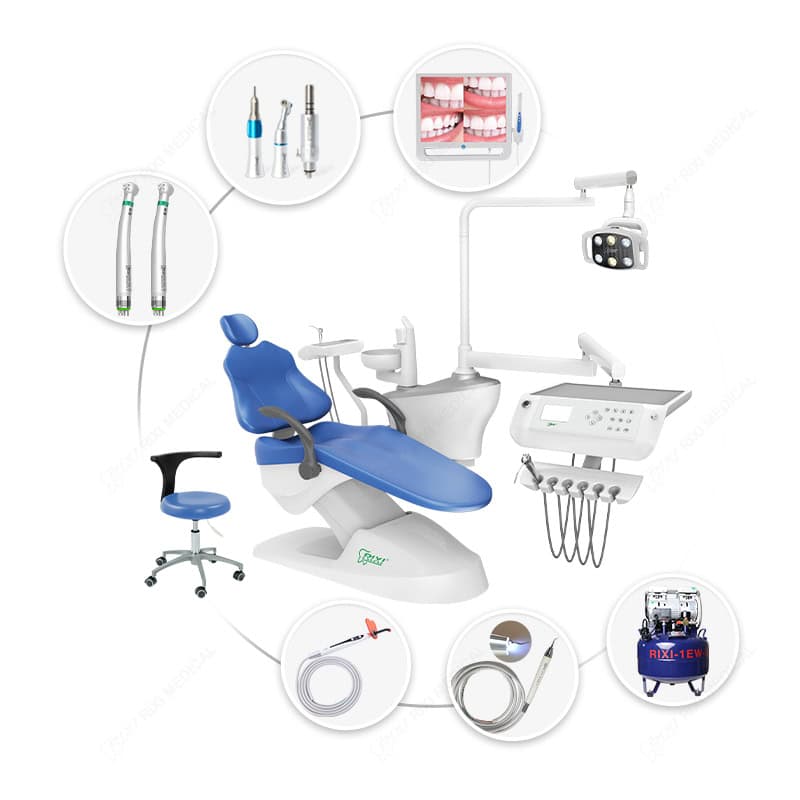
Compare the R1 integrated chair configuration with other candidates only after confirming their selected options. The pictured arrangement may differ from the supplied unit. Ask which tray, light, cuspidor and assistant elements are standard and which require a different mount or additional space.
Test access for people, service and future changes
A tight fit becomes expensive if technicians cannot reach a fuse, valve or internal line without moving cabinetry. Ask the supplier to identify normal service access points and the direction from which panels are removed. Put that access on the room drawing. Do not assume that a chair can be serviced from any side simply because it fits at installation.
Think beyond the first operator. If different clinicians will use the room, ask whether the intended configuration supports their handedness and workflow. “Ambidextrous” can mean different things across products; request a demonstration or written description of what can actually be moved, by whom and with what tools. Avoid claiming a room is flexible until those movements have been tested against the cabinets and utilities.
Include seating in the mock-up. A dentist stool with a backrest may require different space from a smaller stool, particularly when the operator changes position. Confirm the chosen stool’s dimensions and rolling area rather than borrowing a generic circle from a sample plan.

Match utilities and accessories to the chosen configuration
Space planning is also connection planning. Obtain the model-specific electrical, air, water, drainage and suction information for the exact order. Record the location and service access for each connection. A chair may have a compact visible footprint yet require additional space for external equipment or a serviceable utility route.
If the package includes an imaging accessory, monitor or other add-on, show its installed position and cable path on the same drawing. Use the dental accessories range as a list of possibilities, not proof that every part fits every chair. Get written compatibility and mounting confirmation for the selected model and revision.
RIXI Medical is a dental equipment manufacturer and supplier based in Foshan, China. From the supply side, it can clarify the offered assembly, accessory options and documentation. A locally qualified designer, installer or other responsible professional should confirm site conditions and applicable requirements, which vary by jurisdiction.
Use a room-fit check before approving the order
| Check | Evidence to request | Decision to record |
|---|---|---|
| Chair movement | Dimensioned drawing for the ordered model | Does full travel clear doors, cabinets and walls? |
| Delivery equipment | Arm movement and selected accessory layout | Are working and parked positions both usable? |
| People and stools | Scaled room mock-up with actual seating | Can staff enter, work and leave safely? |
| Utilities | Model-specific connection and installation documents | Are connections reachable and coordinated? |
| Service | Panel-removal and routine maintenance access | Can qualified technicians reach service points? |
Mark every answer as confirmed, pending or requiring a design change. If a supplier drawing conflicts with an architect’s plan, reconcile the two before a purchase order or construction release. Keep the approved drawing and option list with the procurement record so a later substitution can be reviewed against the same constraints.
For a different package, such as an R5 chair with accessories, repeat the room-fit check instead of transferring the previous result. Even a small change in tray, light, arm or external equipment can change the usable space.
Frequently asked buyer questions
What is the minimum room size for a dental chair?
There is no reliable single dimension for every chair and room. The answer depends on the ordered configuration, staff movement, utility locations and local requirements. Request a dimensioned drawing and have a qualified local professional test it against the actual room.
Does an integrated chair always save floor space?
It can reduce separate equipment, but the mounted arms and service access still need room. Compare the complete installed envelope with the alternatives, including the parked positions of all accessories.
Should a distributor standardize one chair for every compact clinic?
A standard package can simplify documentation, but each room still needs a fit check. Preserve model and option revisions, then ask the supplier to identify any changes that affect dimensions, connections or service access.
For a proposed room, request the configuration drawing and technical specifications for the chair and accessories you intend to order.
Need Dental Equipment Pricing or Configuration Details?
Contact RIXI Medical for model comparison, distributor pricing, packaging information, OEM/ODM requirements and after-sales support.
Request Product Information