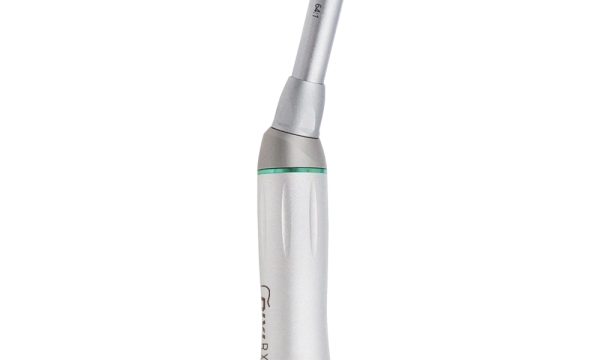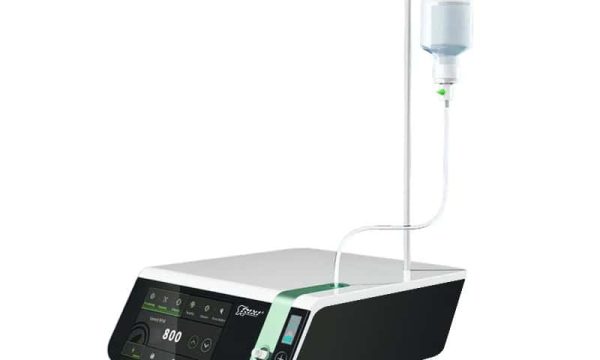
A dental electric motor should not be approved as an isolated control box. The motor, selected ratio, E-type handpiece, illumination, power supply and dental-unit connection form one working configuration. If any interface is left vague, a distributor can receive the correct-looking parts and still be unable to assemble the quoted system.
This checklist is written for clinic owners, procurement teams and distributors comparing a complete motor package. It uses the current RIXI dental electric motor with LED as a documented example, while separating model-specific figures from the general questions that apply to any quotation.
Start with the complete configuration, not the motor name
“Dental electric motor” can refer to a motor integrated into a dental unit or a separate control package. Ask the supplier to identify the control unit, motor handle, cable, power adapter, dental-unit connection and compatible handpiece as individual line items. Record whether the proposal is a new installation, a replacement for an existing motor or a distributor sample.
For an installed clinic, provide accessible photographs of the existing labels and connectors without dismantling the equipment. Include the chair or delivery-unit model, available air and electrical connections, and the handpieces the clinic expects to use. A supplier can then review a defined combination rather than guessing from a generic description.
RIXI Medical lists this model within its dental handpiece equipment range. The illustrated rear panel shows a DC adapter connection, motor cable connection and a 2/4-hole standard connector configuration. Buyers should confirm the exact option supplied for their order and the approved installation method before purchase.
Separate motor speed from handpiece output speed
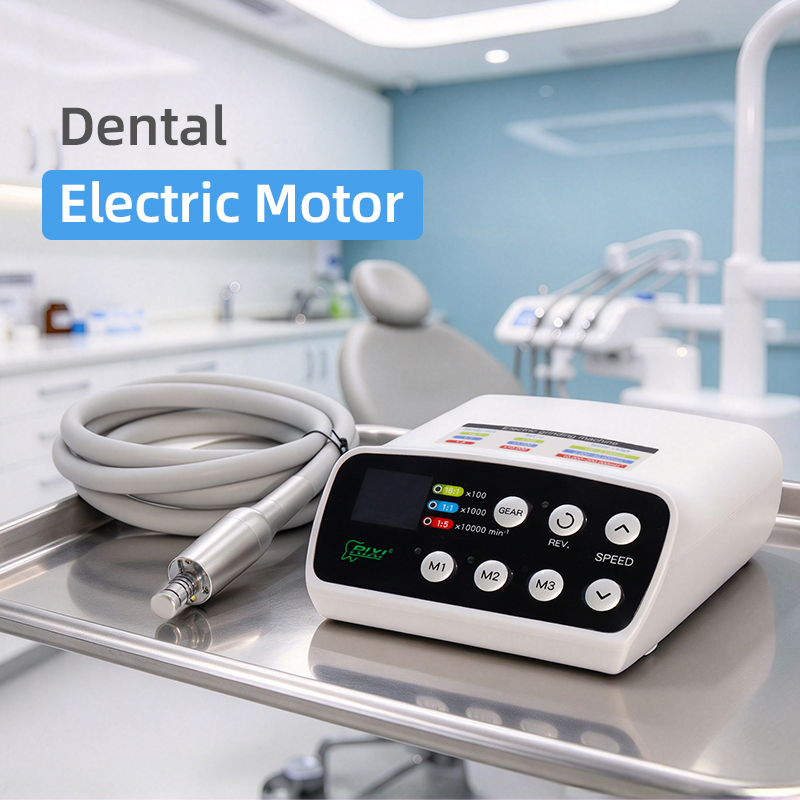
The current product specification gives a motor speed range of 2,000–40,000 rpm. Its panel provides 16:1, 1:1 and 1:5 ratio selections. Those selections must match the mechanical ratio of the attached handpiece; pressing a ratio button does not change the handpiece gearing.
The supplied ratio chart illustrates 100–2,500 min⁻¹ for 16:1, 2,000–40,000 min⁻¹ for 1:1 and 10,000–200,000 min⁻¹ for 1:5. Treat these as model documentation to verify against the current manual and the exact handpiece. In particular, do not present 200,000 rpm as the motor shaft speed, and do not calculate an unlisted operating limit from a ratio alone.
| Quotation field | What the buyer should record | Why it matters |
|---|---|---|
| Motor range | 2,000–40,000 rpm for the illustrated RIXI model | Separates the motor specification from handpiece output |
| Ratio selection | 16:1, 1:1 or 1:5, matched to the attached handpiece | Prevents a display setting from being mistaken for mechanical gearing |
| Motor interface | E-type connector and exact compatible handpiece reference | Visual similarity alone does not prove fit |
| Lighting | Built-in LED at the motor coupling and required supply arrangement | An illuminated handpiece still needs a compatible light path |
| Controls | Forward/reverse, speed adjustment and M1/M2/M3 memory buttons | Confirms the control functions included in the proposed package |

Confirm the E-type handpiece pairing in writing
An E-type label is useful, but it should not be the only compatibility record. Request the exact motor and handpiece models, connection drawing, illumination arrangement and any coupling or adapter reference. Keep the supplier’s written pairing confirmation with the quotation revision.
Where a reduction handpiece is required, compare the proposal with the current low-speed handpiece range. The separately listed 20:1 LED contra-angle and 20:1 non-LED contra-angle illustrate why ratio and lighting must be separate order fields. Do not substitute one for the other without a documented technical and commercial review.
Procurement should also distinguish low-speed or surgical systems from air-turbine handpieces. The related surgical versus high-speed handpiece checklist explains the system-level differences. This article does not recommend clinical settings or determine whether a handpiece is suitable for a procedure.
Check power, controls and installation boundaries
For the illustrated model, the supplied specification states 36 V, 2 A, motor torque of 3.5 N·cm, an approximately Ø22 × 75 mm motor and an approximately 1.65 m motor cable. Confirm the approved adapter, local mains input, connector option and final installation drawing in the quotation. Do not infer the complete site requirement from the low-voltage output label alone.
Ask how the control unit will be positioned, how the cable will be routed and whether the proposed dental unit provides the required connection. Leave adequate service access and avoid routing that creates tension at the motor or control-unit connector. Installation and any utility work should follow the current supplier instructions and be handled by appropriately qualified personnel.
The M1, M2 and M3 buttons can store settings on the illustrated control panel. A receiving checklist should confirm that the buttons, speed adjustment and direction control respond as described in the current manual. Procurement records should capture the accepted configuration, not prescribe clinical use.
Define the package before the purchase order
The product images show a main control unit, motor handle with cable, DC adapter and cable, instruction manual and small spare parts. A photograph is not a contractual packing list. Ask the supplier to state included quantities, optional accessories and exclusions, especially whether any handpiece is supplied.

For distributor orders, create a SKU matrix that links each motor version to the approved connector, adapter, compatible handpieces, manuals and spare-part references. Require change notification for any substituted component. This makes repeat ordering and after-sales identification more reliable than relying on a product photo or informal name.
Use a reproducible receiving test
On arrival, reconcile carton labels and quantities with the approved list before connecting the system. Check the control unit, motor body, cable and connector for shipping damage. Confirm model identity, supplied documents and accessories. A qualified evaluator can then assemble the approved combination according to the manufacturer’s instructions.
Record which handpiece was used, the ratio selected, the direction setting, the observed LED function and any unresolved issue. Do not approve an entire product family based on one undocumented demonstration. Keep the accepted sample reference and manual revision with the purchase record.
Cleaning, maintenance and processing instructions may differ between the motor handle, handpiece and control unit. Never assume that the entire control box or cable assembly can be sterilized. Request the component-specific instructions and contact technical support when a document is missing.
Frequently asked questions
Does the 1:5 setting mean the motor runs at 200,000 rpm?
No. The listed motor range is 2,000–40,000 rpm. The higher figure in the supplied chart refers to illustrated output with a compatible 1:5 speed-increasing handpiece.
Is every E-type handpiece automatically compatible?
No. Confirm the exact motor and handpiece references, gearing, lighting, operating limits and any required coupling in current documentation.
Is a handpiece included with the motor package?
Only if the quotation and packing list explicitly include one. Product photos and ratio labels do not establish the commercial scope.
What should a distributor request before approving a sample?
Request the model sheet, connector option, power and installation requirements, compatible handpiece list, packing list, manuals, spare-part references and change-notification process.
Scope note: This is general procurement guidance. Confirm the exact model specification with the supplier and have installation, operating limits, maintenance and clinical use reviewed by qualified professionals under current instructions and local requirements.
RIXI Medical is a dental equipment manufacturer and supplier in Foshan, China. Request a model-specific specification and configuration review with your dental-unit and handpiece details before placing an order.
Need Dental Equipment Pricing or Configuration Details?
Contact RIXI Medical for model comparison, distributor pricing, packaging information, OEM/ODM requirements and after-sales support.
Request Product Information