A handpiece can match the catalogue description and still fail at installation because the ordered coupling does not match the clinic’s hose, utility arrangement or illumination system. The word “coupling” is also used loosely: one buyer may mean the detachable connection behind a high-speed handpiece, while another means the supply fitting between a motor unit and the dental chair. A useful quotation has to identify both sides of the interface.
This guide is for clinic owners, distributors and procurement teams buying or replacing dental handpiece connections. It concentrates on identification, drawings, utilities, sample approval and repeat-order control—not clinical technique. RIXI Medical is a dental equipment manufacturer and supplier based in Foshan, China. Buyers can review the current dental handpiece range while treating the exact quoted model and supplier documents as the controlling record.
Clarify which interface is being ordered
Do not start with “standard coupling.” Start with the complete equipment path. For an air-driven handpiece, record the dental unit, hose connection, coupling or direct connection, handpiece model, illumination arrangement and any separate water or air controls. For a motor-driven attachment, record the control unit, supply adapter, motor, motor-to-handpiece interface and attached handpiece.
Those two paths contain different interfaces. A fitting that connects a control unit to the chair supply is not automatically the same component as the connection between a motor and a handpiece. RIXI’s current dental electric motor listing, for example, describes an E-type motor interface and asks buyers to confirm a 2-hole or 4-hole supply configuration. These are separate fields and should remain separate on the purchase order.
Build a two-sided connection record
A coupling request should show the equipment on both sides. Ask the supplier to identify the connection by model or controlled reference, not only by a photograph. If the installed equipment label is available, record the manufacturer, model, revision and relevant serial or batch information. Add clear photographs of the hose end, existing coupling, handpiece rear interface and any markings, but do not treat visual resemblance as proof of compatibility.
| Order field | Evidence to request | Reason |
|---|---|---|
| Installed equipment | Model label and current hose or motor details | Defines the known side of the interface |
| Proposed coupling | Part reference, drawing and applicable model list | Prevents a generic name from controlling the order |
| Handpiece | Exact model and rear-interface image | Separates handpiece fit from chair-supply fit |
| Utilities | Supplier specification for air, water and electrical needs | Identifies requirements that mechanical fit cannot confirm |
| Illumination | Light source, contacts or optical path identified in the documentation | Avoids assuming every similar connector supports light |
| Service items | O-rings, seals, tools and replacement references | Supports maintenance and repeat orders |
Separate mechanical fit from air, water and electrical requirements
A coupling that attaches securely may still be the wrong specification. Ask how drive air, exhaust air, water and chip air are routed for the ordered configuration, where applicable. Record the supplier’s stated pressure, flow and air-quality requirements rather than copying values from a different model. If the order involves a motor or control unit, add the approved power adapter, input, cable and chair-supply connection to the same configuration record.
The broader high-speed handpiece comparison guide explains why RPM alone cannot define an order. Coupling procurement needs the same discipline: physical attachment, utility compatibility and permitted operating arrangement are different checks. Local electrical and equipment-installation requirements vary, so qualified local personnel should review the final configuration.
Confirm the illumination and control path
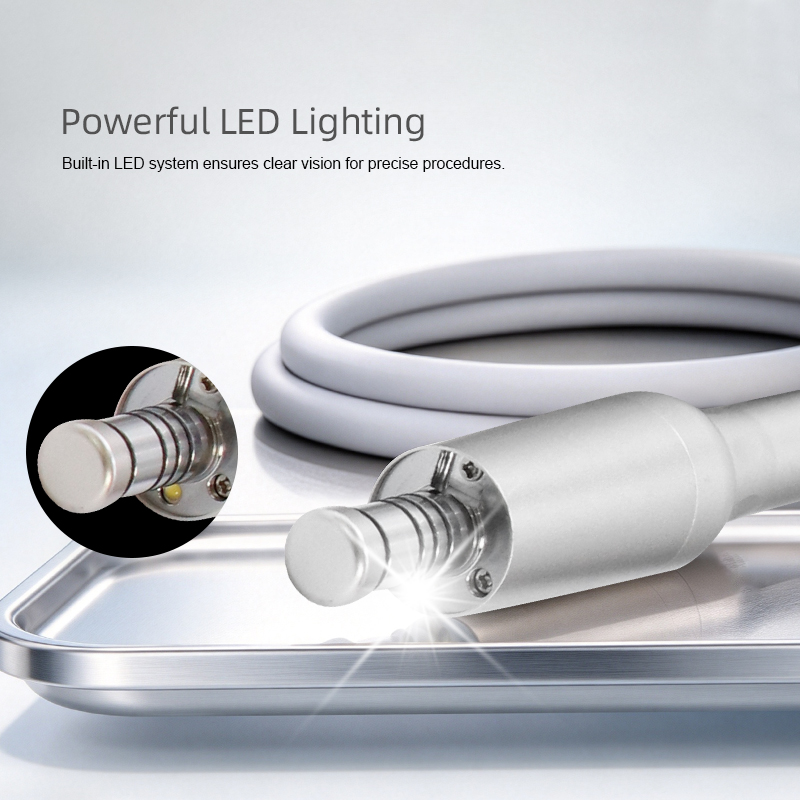
“LED handpiece” does not describe the whole light path. Illumination may depend on the handpiece, coupling, motor, dental unit or a combination of components. Ask the supplier to identify the source, contacts or optical path used by the quoted system and to state which component provides power. Also confirm whether the chair or motor controls can operate the selected configuration as documented.
Do not promise that an adapter will preserve illumination, spray control or another function merely because it makes two parts connect. If a quotation offers illuminated and non-illuminated variants, give each a separate model or SKU row. The distributor’s catalogue, carton label and replacement-parts file should use the same distinction.
Treat quick-release and swivel claims as model-specific
Suppliers may use terms such as quick-connect, quick-release, coupler or swivel. Terminology alone does not establish interchangeability. Ask what movement is permitted, how the release mechanism is operated, which seals or retaining parts are involved, and whether any tool is required. Request the current instructions for attachment, removal, care and inspection.
A rotating connection can affect hose handling, but procurement teams should not turn that feature into a universal ergonomic claim. Record the supplied configuration and have the intended users evaluate an identified sample under the clinic’s normal equipment conditions. If the sample uses a different hose, coupling or accessory from the quotation, the review is not reproducible.
Request drawings and service references before approval
A connection drawing should identify the interface dimensions or controlled profile that the supplier is willing to guarantee. Ask for the coupling reference, applicable handpiece list, hose or supply configuration, seals, tools and replaceable items. Where the supplier restricts service to qualified personnel, put that boundary into the purchasing and support file.
The handpiece replacement-parts identification guide is relevant when a clinic is trying to distinguish a coupling issue from an internal handpiece issue. Procurement staff should document the observed mismatch without diagnosing a fault. RIXI’s technical support page can be used to request the current model-specific evidence and service route.

Approve a sample without improvising adapters
Use a controlled, non-clinical sample review before releasing a larger clinic or distributor order. Confirm the sample model, coupling reference, installed equipment, hose or motor, illumination option and document revision. Attach and remove components only as described by the supplier. Do not force an uncertain fit, modify a seal or combine adapters to make an undocumented arrangement operate.
The acceptance record can cover secure attachment, release operation, visible leakage or looseness, expected illumination and control response, and any supplier-approved functional checks. Keep observations factual. A sample pass means the identified configuration matched the agreed evidence; it does not establish compatibility with every handpiece in the same product family.
Control replacement couplings and repeat orders
Keep the approved coupling as its own stock item even when it is supplied in a handpiece package. Record the current reference, compatible equipment, included seals or tools, packaging label and approved drawing revision. For mixed clinics, group stock by verified interface rather than by appearance. For distributors, prevent illuminated, non-illuminated and different supply configurations from sharing one ambiguous SKU.
Require notification before a supplier changes the body, internal valve arrangement, contacts, seals, finish, markings or packaging reference. At receipt, compare labels and visible features with the approved sample, then hold mismatches for review. Buyers can use the dental equipment directory to locate related product records and the contact page to request drawings, configuration confirmation or distributor pricing.
Frequently asked questions
Is a 2-hole or 4-hole supply connection the same as a handpiece coupling?
Not necessarily. The terms may describe different points in the equipment path. Identify the chair or control-unit supply connection, coupling, motor interface and handpiece interface as separate fields, then confirm the exact quoted arrangement.
Can photographs confirm that two couplings are interchangeable?
No. Photographs help identify markings and visible geometry, but they do not confirm internal air or water routing, illumination, seals, permitted operating conditions or service restrictions. Request model-linked documentation and a controlled sample.
What should a distributor keep for replacement orders?
Keep the coupling part reference, applicable equipment list, drawing revision, illumination and utility configuration, seal or tool references, approved sample images and packaging label. Record changes before releasing repeat stock.
Should a clinic test a coupling on every handpiece?
Use a representative, documented sample plan agreed with the supplier and qualified local personnel. Do not assume one successful attachment proves compatibility across different models, revisions or illumination systems.
Scope note: This is general procurement guidance. Confirm model-specific connections, utilities, care instructions and service boundaries with the supplier, and have qualified local professionals review installation and use requirements.
For an order-specific coupling matrix, drawing set or OEM/ODM enquiry, send RIXI Medical the installed equipment details, intended handpiece models and required supply configuration.
Need Dental Equipment Pricing or Configuration Details?
Contact RIXI Medical for model comparison, distributor pricing, packaging information, OEM/ODM requirements and after-sales support.
Request Product Information