An autoclave replacement part can look correct in a photograph and still be wrong for the installed machine. Production revisions, electrical versions, accessory designs and different suppliers’ part names can all complicate an apparently simple reorder. Buying by appearance alone makes the distributor or clinic carry the uncertainty into the service visit.
This guide addresses identifying and ordering parts, rather than diagnosing faults or instructing staff to repair a sterilizer. It is for distributors, clinic purchasing teams and service coordinators who need to turn a support request into a traceable order. Inspection and repair must remain with personnel qualified for the task and follow the current manufacturer’s instructions.
Identify the installed unit before identifying the part
Start with the machine’s exact model designation, serial or batch identifier where provided, rated supply and purchase reference. Photograph the nameplate clearly, without relying on a handwritten model name. Keep the original configuration sheet or packing list available, because a commercial product name may cover more than one version.
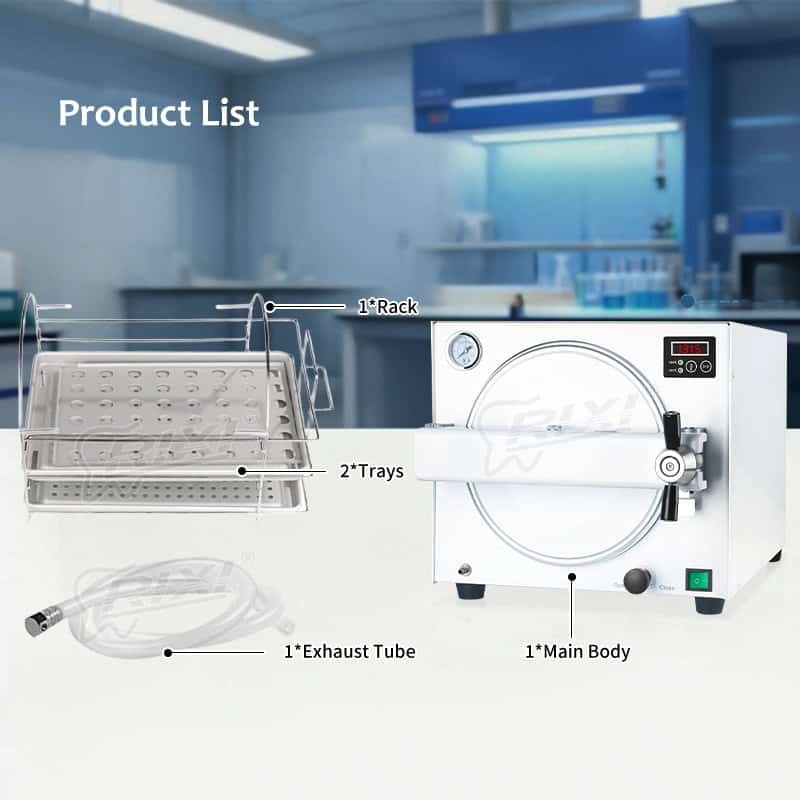
The front-door autoclave product page is useful for identifying the general format, but its photographs cannot establish the correct service part for an installed unit. Ask the supplier to confirm the machine reference against its own records. If a label is missing or unreadable, report that gap explicitly instead of assuming a match.
For distributor fleets, keep a cross-reference between the customer’s equipment identifier, the sales SKU and the underlying manufacturer model. This prevents service enquiries from becoming mixed up when several visually similar units were sold under different brand names or electrical configurations.
Describe the request without turning it into a diagnosis
Separate the observed issue from the requested part. A useful report states what the customer observed, when it occurred, any displayed message and the equipment identifier. It should not describe a guessed cause as confirmed. If a technician has already assessed the machine, include their written conclusion and part identification.
Ask the supplier what evidence is needed. Accessible exterior photographs may be enough to identify an accessory; internal components may require a qualified service inspection. Do not open electrical or pressure-related assemblies simply to obtain a better picture. The manufacturer’s access and isolation instructions govern what may be inspected.
Provide photographs with orientation and context: an overall view, the relevant accessible location and a readable reference if present. A close-up without context can hide whether the part belongs to the door, tray rack or another assembly. Keep images attached to the specific service case.
Use the manufacturer’s reference as the ordering anchor
Request a part number, description, revision information and a statement of which equipment versions it fits. If an exploded diagram is available, record its document revision and item position. The order should not rely only on a nickname such as “door rubber” or “blue knob.”
| Order field | Purpose |
|---|---|
| Installed model and identifier | Locates the machine configuration in supplier records |
| Manufacturer part reference | Distinguishes the requested item from visual alternatives |
| Diagram position and revision | Shows where the part belongs and which drawing was used |
| Quantity and package contents | Clarifies whether the item is individual or an assembly |
| Supersession information | Explains whether a newer reference replaces the former one |
| Installation responsibility | Identifies who is qualified and authorized to perform the work |
A supplier may offer a replacement assembly instead of an individual component. Ask what is included and which associated items are required. Compare the total package and installation implications before approving an alternative. Do not assume that every item in a kit can be substituted independently.
Control substitutions and superseded references
When a reference changes, request the reason, affected models and any related instruction changes. Distinguish a packaging-only change from a change to material, dimensions, connections or function. Record the supplier’s compatibility statement with the service case and purchase order.
Do not accept “same as the photo” as the only evidence. A photograph cannot establish a material specification or electrical rating. For an alternative supplier, ask what documentation supports the proposed match and who will accept responsibility for reviewing it. A lower price does not resolve missing compatibility information.
Use the tabletop autoclave configuration and sterilizer equipment range to keep different machine families distinct. A part for one model should not enter another model’s stock bin merely because both units have the same advertised chamber capacity.

Inspect the delivery against the approved order
On receipt, compare the reference, quantity, packaging condition and included instructions with the purchase record. Keep lot or identification information where provided. If the delivered item is different, hold it for review before it reaches the service technician. Record the discrepancy with clear photographs.
Do not alter the original part record to make a mismatch appear acceptable. If the supplier confirms a valid supersession, attach that confirmation and update the stock reference through the agreed change process. Separate unapproved alternatives physically so they cannot be issued accidentally.
For a distributor, incoming inspection should also link the item to the customer service case. A correct part delivered to the wrong clinic can be as disruptive as an incorrect part. Agree on who checks the shipment and who confirms receipt before scheduling work.
Make the closure record useful for the next order
After qualified service work, record which part was used, the installed machine identifier, relevant instruction revision and the technician’s completion documentation. Ask the responsible service party what checks are required before returning the equipment to use. A procurement receipt alone does not demonstrate safe operation.
Maintain a service history that can distinguish recurring enquiries from unrelated incidents. Avoid building a universal replacement schedule from one case. Stock decisions should follow documented model requirements, actual ordering history, supplier guidance and the distributor’s service capability.
RIXI Medical is a dental equipment manufacturer and supplier in Foshan, China. Its technical support information can help route model-document requests, while transaction-specific availability, warranty terms and delivery arrangements need written confirmation for the order.
Buyer questions
Can a part be ordered from a photo alone?
A photo may begin the enquiry, but the order should include the equipment identifier, manufacturer part reference and compatibility confirmation. Some parts need a qualified inspection to identify safely.
What if the original reference is discontinued?
Request a documented supersession or alternative recommendation tied to the installed model, including associated parts and instruction changes. Keep that evidence with the order.
Scope: This article covers procurement records and identification. It does not provide fault diagnosis, repair steps or a clinical processing procedure.
Request a model-specific parts identification review with the machine nameplate, purchase reference and the evidence requested by the supplier.
Need Dental Equipment Pricing or Configuration Details?
Contact RIXI Medical for model comparison, distributor pricing, packaging information, OEM/ODM requirements and after-sales support.
Request Product Information